 Mayanfinance
 auctions select the best driver offer for a cross-chain order
Mayanfinance auctions select the best driver offer for an order’s requested destination tokens. Drivers compete on Solana, and the winning driver executes the fill through the selected transfer method. Swift distinguishes orders with a minimum acceptable output from eligible orders that fix the output before execution. A winning offer must satisfy those settlement terms. The transfer method also determines where the driver obtains funds and how delivery relates to reimbursement.
Updated on
Minimum-Output and Exact-Out Swift Orders
Swift quotes offer minimum-output and exact-out settlement, and the
swiftAuctionMode
field identifies the terms that apply to an order. These modes change what the recipient can expect from a successful auction fill.
Minimum-Output Orders
Mode
2
requires a fill at or above
minAmountOut
, typically near
expectedAmountOut
. The expected amount remains an estimate, while the minimum sets the signed lower bound. An amount below the estimate can therefore satisfy the order.
Exact-Out Orders
Mode
3
makes
expectedAmountOut
the exact amount that the recipient receives when the order completes.
Asset Eligibility
Guaranteed Price supports eligible USDC-to-USDC, USDT-to-USDT and ETH-to-ETH transfers across supported chains. Other same-asset transfers and cross-asset swaps do not qualify. The asset match establishes the supported category, while the returned quote establishes whether that particular order has exact-out terms.
Per-Quote Availability
A token pair can return mode
3
for one order and mode
2
for another. An integration must read the field on each quote. Reusing a previous order’s settlement label could misrepresent the new order’s output promise.
Which Driver Bid Wins the Auction?
Swift drivers bid on Solana and win minimum-output auctions by offering more of the requested destination token. The requested token, destination and signed amount terms define the order that they are competing to fill. Each offer concerns the requested output token, so a different asset does not satisfy the same order.
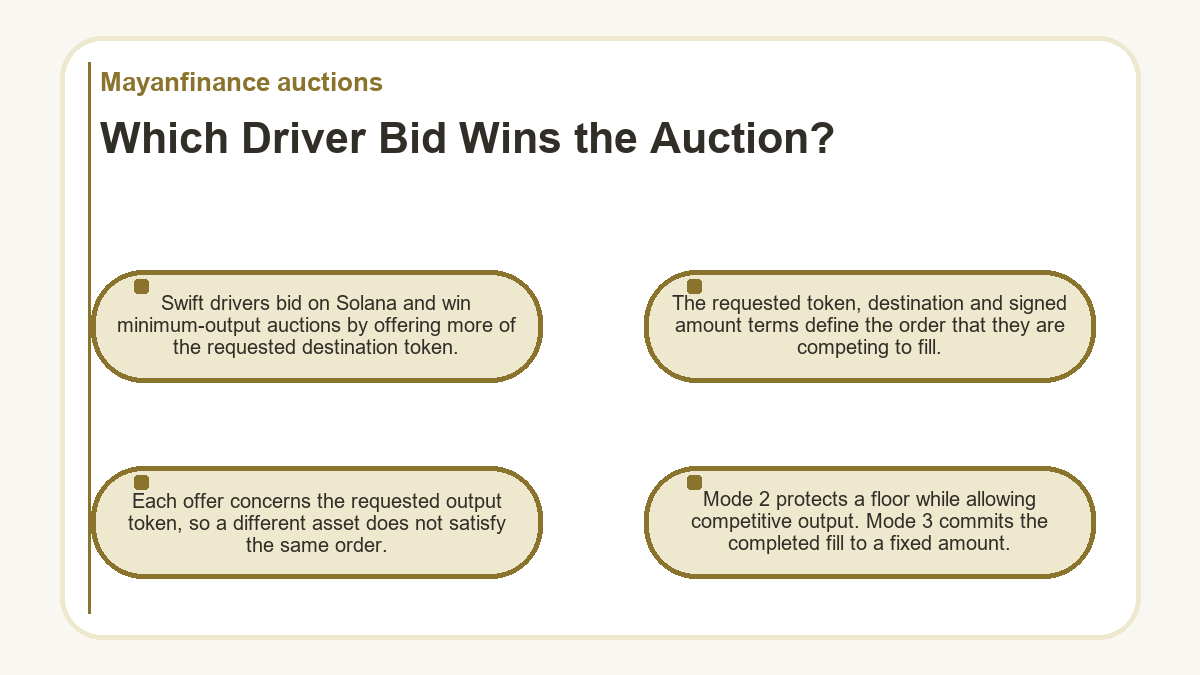
Mode
2
protects a floor while allowing competitive output. Mode
3
commits the completed fill to a fixed amount.
Driver Capital and Source-Chain Reimbursement
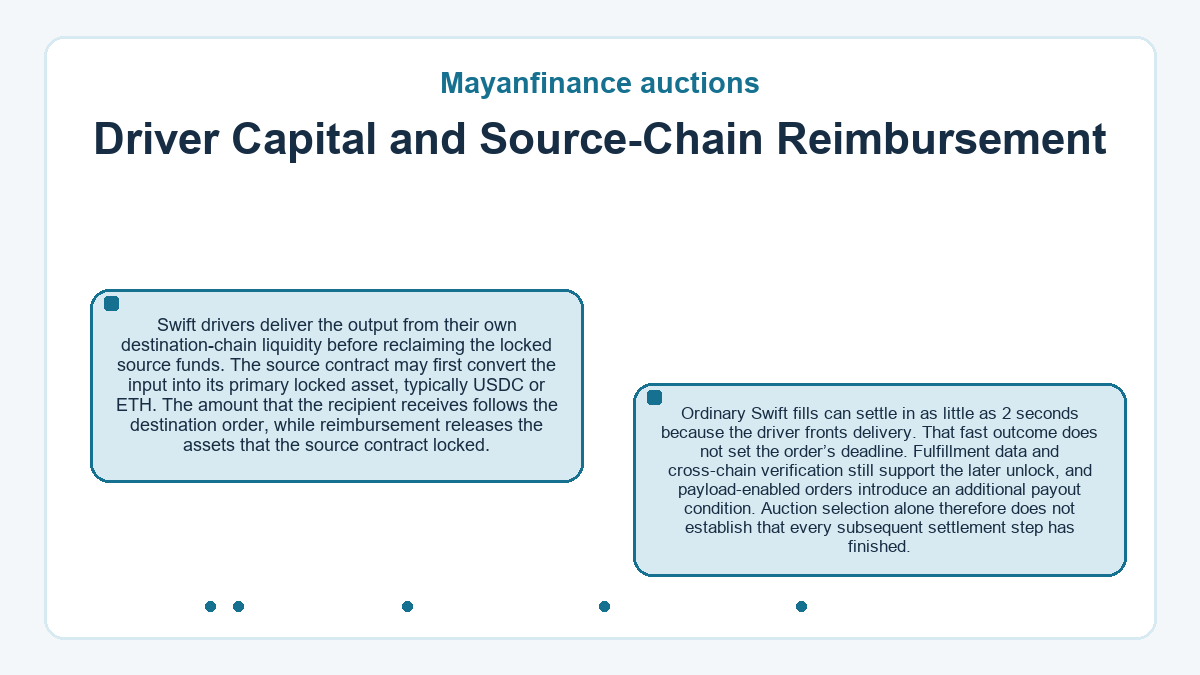
Swift drivers deliver the output from their own destination-chain liquidity before reclaiming the locked source funds. The source contract may first convert the input into its primary locked asset, typically USDC or ETH. The amount that the recipient receives follows the destination order, while reimbursement releases the assets that the source contract locked.
Ordinary Swift fills can settle in as little as 2 seconds because the driver fronts delivery. That fast outcome does not set the order’s deadline. Fulfillment data and cross-chain verification still support the later unlock, and payload-enabled orders introduce an additional payout condition. Auction selection alone therefore does not establish that every subsequent settlement step has finished.
Conversion Auctions Within MCTP and Wormhole Swap
MCTP and Wormhole Swap also use driver competition on Solana, with different conversion work behind their winning offers. The recipient can receive tokens on another supported chain.
MCTP moves native USDC through Circle’s Cross-Chain Transfer Protocol, or CCTP. Drivers compete to convert that USDC into the requested output on the destination chain. A plain USDC-to-USDC transfer has no destination-token swap. Fast MCTP retains the same general structure while using CCTPv2.
Wormhole Swap uses the Wormhole Token Bridge and embeds swap details in cross-chain messages. Its winning driver performs a flash swap on Solana, obtaining funds and sending the promised output atomically within that transaction. A Solana destination receives the output there; other destinations require onward delivery through the Token Bridge.
Costs Behind the Offered Output
Swift has no protocol fee, while other methods can charge one; the quote returns the live rate as
protocolBps
. An optional integrator fee adds to any protocol charge. Relayer fees vary by route and can use different token denominations, so their raw amounts do not share one unit. The
clientRelayerFeeSuccess
field already aggregates successful-swap relayer costs in dollars. Adding that aggregate to its component fees would count those components twice. The refund-cost aggregate covers the separate refund outcome.
Deadlines and Unfilled Orders
An unfilled order becomes refundable after its deadline, which the quote exposes through
deadline64
. A driver cannot fill the order after that boundary. Minimum-output protection also prevents a completed fill below the signed floor: an order that cannot meet it follows the refund path. Guaranteed Price orders retain a deadline too. Their fixed output promise applies to a completed fill and does not promise completion at a particular time. A refund carries its own onchain relayer cost, available before signing through the quote’s refund-fee fields.
Swift returns the locked source asset on a refund. If the route converted the original token before opening the order, that converted asset becomes the refund asset. A deadline therefore does not promise restoration of the original token or an identical balance after costs.
Payload Orders and Staged Payouts
Current Swift payload orders stage the destination payout and complete it after a settlement step that validates the payload. A winning driver and staged funds do not alone establish final payout. A custom payload can carry instructions for a destination action. The SDK forwards supported custom payload bytes without interpreting them; the destination logic handles their meaning. Payload support depends on the route and chain, so the quote must support the intended payload before execution.
The original Swift contracts used different payload handling; integrations that have not migrated cannot assume the current staging behavior.
A Swift Quote Before and After Commitment
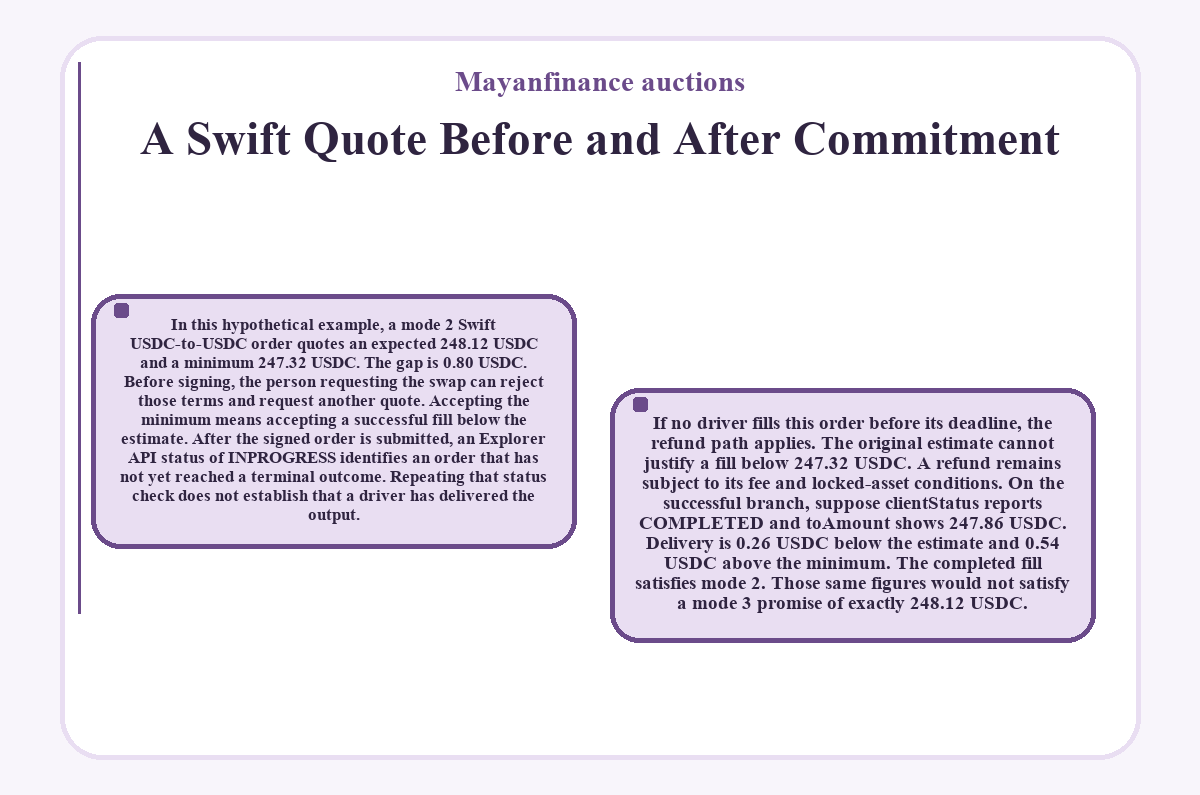
In this hypothetical example, a mode
2
Swift USDC-to-USDC order quotes an expected 248.12 USDC and a minimum 247.32 USDC. The gap is 0.80 USDC. Before signing, the person requesting the swap can reject those terms and request another quote. Accepting the minimum means accepting a successful fill below the estimate.
After the signed order is submitted, an Explorer API status of
INPROGRESS
identifies an order that has not yet reached a terminal outcome. Repeating that status check does not establish that a driver has delivered the output.
If no driver fills this order before its deadline, the refund path applies. The original estimate cannot justify a fill below 247.32 USDC. A refund remains subject to its fee and locked-asset conditions.
On the successful branch, suppose
clientStatus
reports
COMPLETED
and
toAmount
shows 247.86 USDC. Delivery is 0.26 USDC below the estimate and 0.54 USDC above the minimum. The completed fill satisfies mode
2
. Those same figures would not satisfy a mode
3
promise of exactly 248.12 USDC.
Useful questions about Mayanfinance auctions
Does fetchQuote Return Individual Driver Bids?
fetchQuote returns route quotes for a token pair, rather than an item for each competing driver. Its default response contains at most two routes, prioritizing the quickest route and the best-return route; one item suffices when the same route serves both purposes. Choosing among those routes selects execution terms. Driver competition then determines the winning offer within the selected method.
Can an ERC20 Auction Order Avoid a Separate Approval Transaction?
An ERC20 input can use an EIP-2612 permit if the token supports that authorization method. Otherwise, execution requires an allowance for the Mayan Forwarder before the swap. Approval concerns access to the source tokens; the auction still governs the destination fill. Permit support belongs to the input token, so an integration must retain the allowance path for tokens without it.
When Does an EVM-source Swift Fill Credit a Referrer Fee?
For a single referrer wallet, a current Swift order with an EVM source credits that wallet’s fee manager balance when the source order unlocks. Split fees instead credit a shared address derived from the wallet list. The fee uses the locked source asset, and the order must complete to earn it. Destination delivery can precede that unlock. A recipient’s completed payout therefore does not by itself confirm that the integrator has already received a fee in its wallet.
Can a Gasless Swift Order Use a Separate Refund Wallet?
A gasless Swift order must return its refund to the wallet that signed the order. The SDK rejects swiftRefundAddress on a gasless quote. A custom source-chain refund wallet requires a non-gasless Swift quote and a valid nonzero address. Other quote types ignore that option and refund to the swapper wallet, so the selected route matters before signing.
Could Address Screening Stop an Otherwise Competitive Auction Order?
Mayan may prevent an order from proceeding when transaction screening flags an address. Its controls use third-party risk data, including Chainalysis and Hermod by zeroShadow. A competitive offer does not override those processing controls.