 Mayanfinance
 Routes Cross-Chain Transfers Through Swift, MCTP and Wormhole Swap
Mayanfinance offers Swift, MCTP and Wormhole Swap as different settlement methods for cross-chain token transfers. Swift uses drivers’ destination-chain capital, MCTP moves native USDC through Circle’s CCTP and Wormhole Swap uses the Wormhole Token Bridge. The available chain pair, transfer size and desired output narrow the choice. Within those families, settlement modes and payload support add further distinctions that affect the transfer.
Updated on
Destination Delivery Through Driver Competition
Swift, MCTP and Wormhole Swap all combine cross-chain delivery with competitive driver execution for the requested destination asset. Their auctions run on Solana, while token movement follows each method’s architecture. Quote responses distinguish four
type
values:
SWIFT
,
MCTP
,
FAST_MCTP
and
WH
. Fast MCTP belongs to the MCTP family, which explains the additional route label. Availability still depends on the particular chain pair and token pair. A supported network may accept origins, destinations or both.
Driver Capital, Native USDC and the Token Bridge
Swift is the intent-based route that uses a driver’s existing capital on the destination chain to make the payout. Its source contract locks the input, sometimes after conversion into USDC or ETH. The driver delivers the output before reclaiming the locked source funds, which allows ordinary fills in as little as 2 seconds.
MCTP, short for Mayan-Circle Transfer Protocol, routes the cross-chain leg through native USDC using Circle’s CCTP. The source-side conversion supplies USDC when the input requires it. Drivers compete on Solana to handle the destination conversion into the requested output token. A plain USDC-to-USDC transfer needs no destination trade, so MCTP serves both stablecoin movement and swaps into another asset. USDC acts as the transport asset even when a different token appears at either end.
Fast MCTP preserves that USDC-based structure and uses Circle CCTPv2 for settlement in as little as 5 seconds. The
FAST_MCTP
quote type has distinct protocol-fee rules.
Wormhole Swap uses the Wormhole Token Bridge’s mint-and-burn architecture and carries swap details in cross-chain messages. Drivers compete for execution on Solana, where the winning driver performs a flash swap. The driver obtains funds and sends the promised swap output atomically within that Solana transaction. A Solana destination receives the output directly through a relayer. For another destination chain, relayers send the tokens onward through the Token Bridge. That onward bridge transfer differs from Swift’s payout using destination inventory. Wormhole Swap targets low-slippage transfers of high-value SOL and ETH.
Mayanfinance: Swift, MCTP or Wormhole Swap?
- Destination Delivery Through Driver Competition
- Driver Capital, Native USDC and the Token Bridge
- Which Method Fits a Larger Transfer?
- Protocol Charges and Quote-Level Costs
Wormhole Swap targets settlement under a minute. Quote fields
etaSeconds
and
clientEta
supply the selected route’s estimated duration; neither field replaces the order’s actual deadline.
Which Method Fits a Larger Transfer?
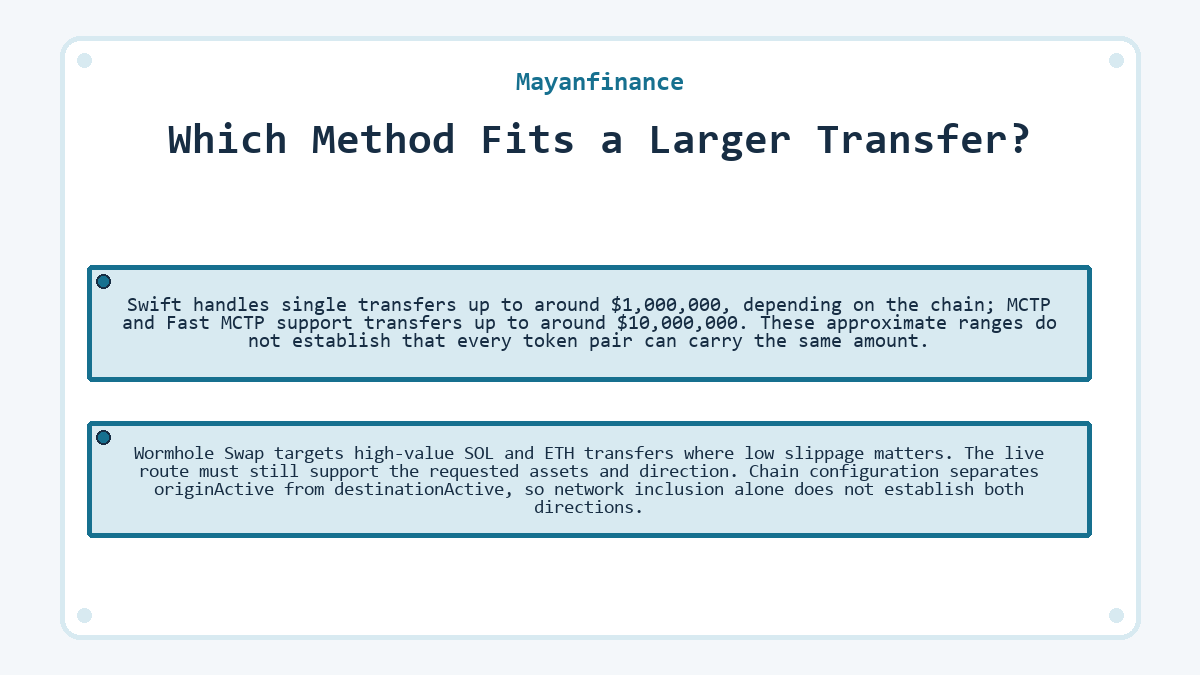
Swift handles single transfers up to around $1,000,000, depending on the chain; MCTP and Fast MCTP support transfers up to around $10,000,000. These approximate ranges do not establish that every token pair can carry the same amount. Wormhole Swap targets high-value SOL and ETH transfers where low slippage matters. The live route must still support the requested assets and direction. Chain configuration separates
originActive
from
destinationActive
, so network inclusion alone does not establish both directions.
Protocol Charges and Quote-Level Costs
Swift currently charges no protocol fee, while the other methods apply route-specific rates that affect the comparison.
Standard MCTP charges no protocol fee when the output token is USDC.
For other output tokens, its stated protocol rate is 3 basis points, or 0.03%. Fast MCTP lists 3 basis points independently of that standard-MCTP exemption. Wormhole Swap lists 10 basis points, or 0.10%. The quote’s
protocolBps
field supplies the applicable live rate because protocol fees can change.
Relayer charges use different token units across methods. On
WH
quotes,
solanaRelayerFee
uses the input token and
redeemRelayerFee
uses the output token. MCTP denominates both fields in USDC;
SWIFT
reports zero for these two fields. The dollar-valued
clientRelayerFeeSuccess
already aggregates the success-case relayer charges. Adding that aggregate to its component charges would double count them. A refund has a separate quoted relayer cost in
clientRelayerFeeRefund
.
An integrator’s referrer fee adds to the protocol charge. Comparing expected output alongside the fee breakdown captures costs that a protocol percentage alone leaves out.
Can a Swift Quote Fix the Output Amount?
A Swift quote with
swiftAuctionMode
set to
3
commits to exactly
expectedAmountOut
if the order fills.
Mode
2
commits to at least
minAmountOut
, with
expectedAmountOut
providing an estimate. A
SWIFT
type alone therefore does not establish an exact output.
Guaranteed Price eligibility covers matching USDC, USDT or ETH across supported chains. Other same-asset transfers and cross-asset swaps do not qualify. Individual quote modes can still differ for an eligible pair.
In a hypothetical comparison, a payment must deliver USDC on Solana from USDC on Arbitrum, with the output fixed before signing. Two hypothetical Swift quotes offer this transfer, one with mode
2
and one with mode
3
.
The mode
3
quote supports that commitment through exact-out settlement. Its
expectedAmountOut
gives the promised output if the order fills. Mode
2
supports only the signed minimum, so its expected output cannot serve as a fixed payment amount. An unfilled mode
3
order still becomes refundable at its deadline; exact-out does not promise completion by a particular time.
Payload Support Within the Route Families
Payload-enabled routes carry data for destination applications, which makes route support material to deposits, staking and other contract actions. MCTP, Fast MCTP and Swift support custom payloads under route-specific conditions. The SDK passes the bytes unchanged, and destination logic must decode them. Requesting payload-capable quotes uses
{ payload: 'true' }
as the second
fetchQuote
argument. A route that does not accept custom payloads may reject, ignore or override caller-supplied bytes. Payload size limits also differ across chains and routes; larger messages can increase costs or cause failure.
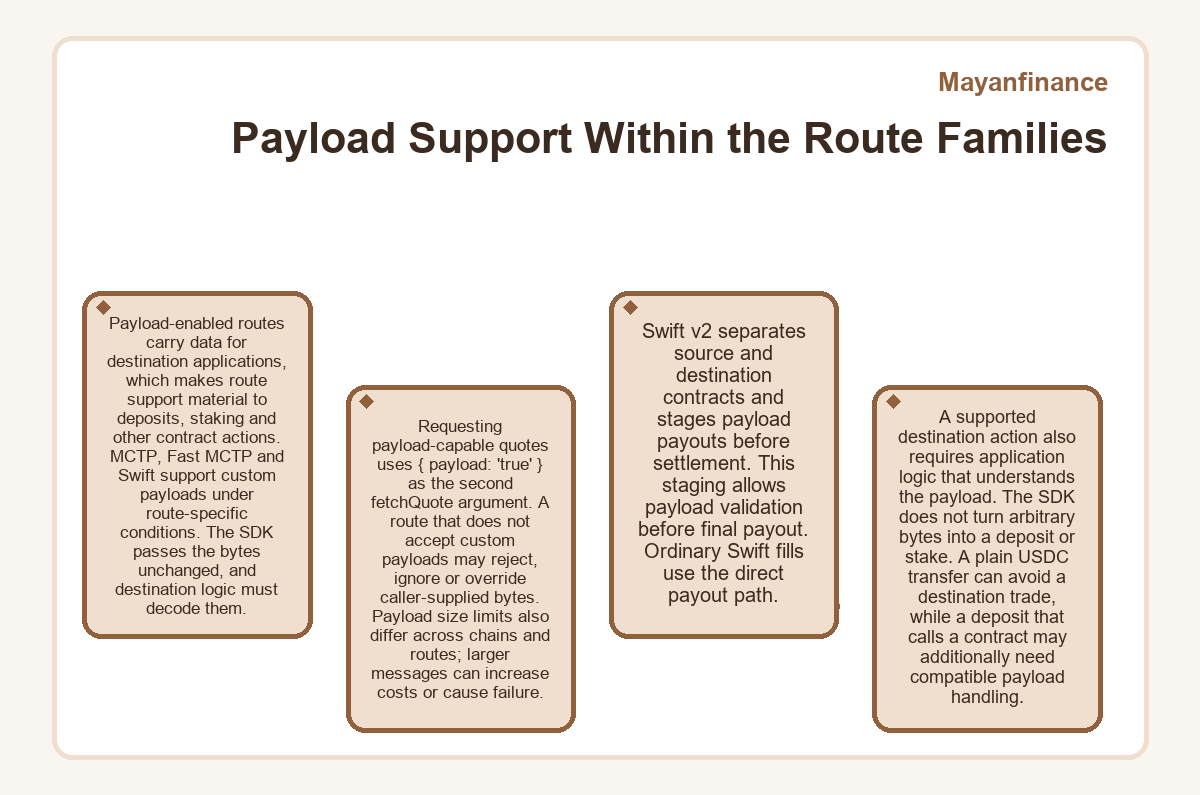
Swift v2 separates source and destination contracts and stages payload payouts before settlement. This staging allows payload validation before final payout. Ordinary Swift fills use the direct payout path. A supported destination action also requires application logic that understands the payload. The SDK does not turn arbitrary bytes into a deposit or stake. A plain USDC transfer can avoid a destination trade, while a deposit that calls a contract may additionally need compatible payload handling.
Everyday questions about Mayanfinance
Why Can a Swift Refund Contain a Different Token?
A Swift refund returns the asset that the source contract locked, which may differ from the original input token. Some orders first convert the input into the primary locked asset, typically USDC or ETH on the source chain. The refund then returns that converted asset. A refund relayer fee can also apply.
Does MCTP Pay a Referrer on a Plain USDC Transfer?
Standard MCTP pays a referrer only when the completed order includes a destination-chain swap. A plain USDC-to-USDC transfer has no such swap and earns no referrer fee. Fast MCTP uses a separate rule that requires completion without the same destination-swap condition. Protocol fees and relayer charges remain separate.
Which Swift Version Pays Referrers on the Source Chain?
Swift v2 collects referrer fees from the locked source asset and settles them on the source chain. Original Swift collected them from the destination output token. With an EVM source, Swift v2 credits the fee manager when the order unlocks. Destination delivery alone therefore does not establish receipt in the referrer’s wallet.
Are Gasless Execution and Destination Gas Drop the Same Route Feature?
Gasless execution covers source-side submission, while gas drop delivers native tokens for destination-chain transactions. On eligible gasless routes, a relayer submits the order after the user signs a message. Gas drop supplies native gas alongside the output and does not trigger by default when the destination wallet already has enough. Each feature has its own eligibility conditions.
Can a HyperCore Deposit Use an Arbitrary Swift Payload?
A HyperCore deposit rejects a caller-supplied payload because the route constructs its own fixed payload. HyperCore withdrawals use a different branch that accepts a custom payload within the order’s hook data. Both use Swift v2, so the family name alone does not identify payload support.